Policy
Post-Construction Controls (PCC) — Lincoln Township
Describes Lincoln Township's post-construction stormwater controls procedure, including an EGLE decision flow chart and five performance standards that apply if the township's storm sewer system is connected into or the township redevelops its site.
Summary written automatically. The full text below is the record.
Lincoln Township Post Construction Controls (PCC)
Ordinance or other Regulatory Mechanism
No ordinances or regulatory mechanisms are implemented as Lincoln Township owns all the land and surrounding area of their MS4 system. If at any time the storm sewer system is connected into, or Lincoln Township redevelops their site, then this procedure will be followed.
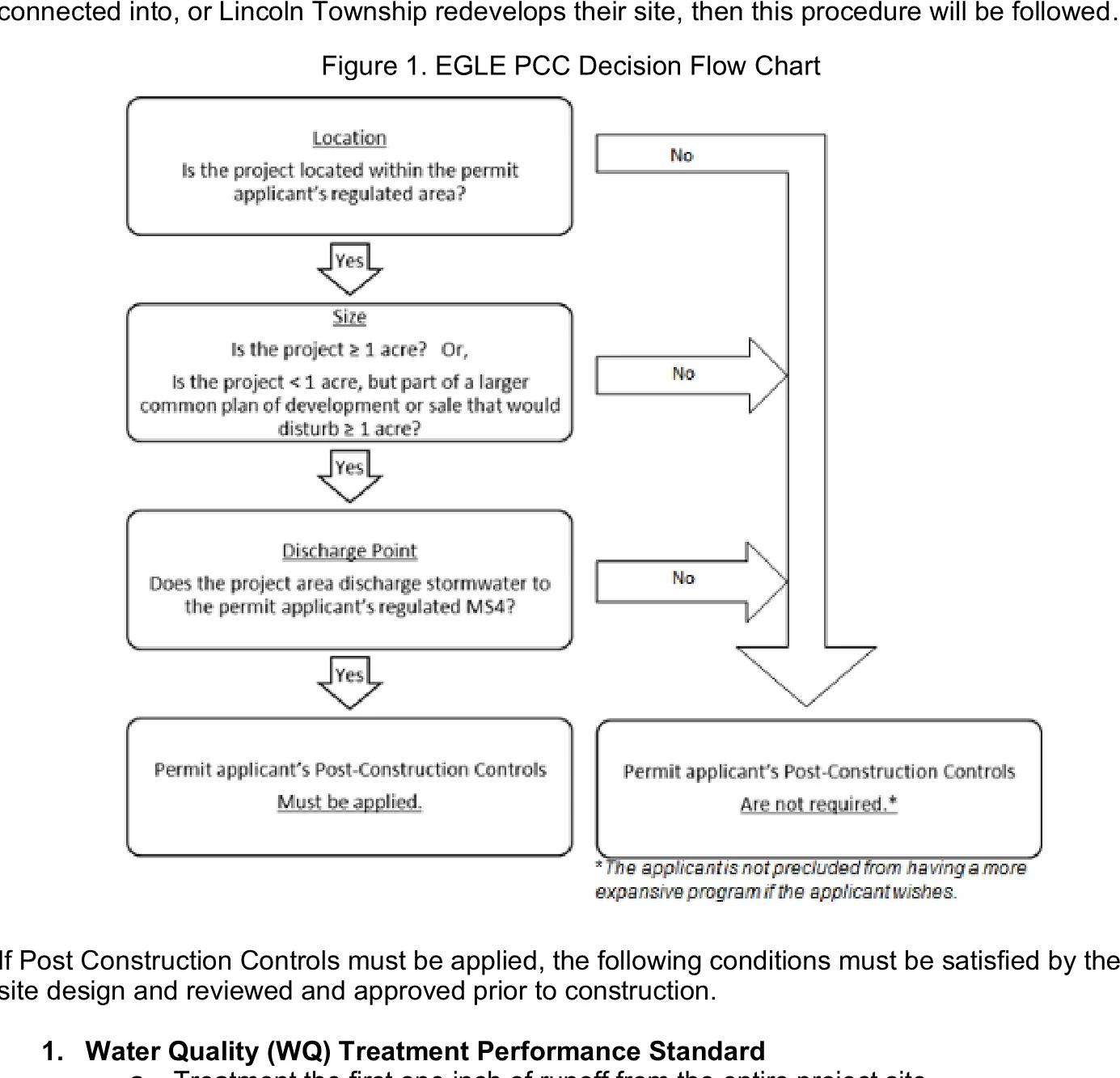 (opens the full-size diagram in a new tab)
Read a text description of this diagram
If Post Construction Controls must be applied, the following conditions must be satisfied by the site design and reviewed and approved prior to construction.
- 1.Water Quality (WQ) Treatment Performance Standard
- a.Treatment the first one inch of runoff from the entire project site
- b.Best Management Practices (BMPs) be designed on a site-specific basis to reduce post-development total suspended solids loadings by 80 percent or achieve a discharge concentration of total suspended solids not to exceed 80 milligrams per liter.
- 2.Channel Protection Performance Standard
- a.The post-construction runoff rate and volume of discharges not exceed the pre-development rate and volume for all storms up to the two-year, 24-hour storm at the project site. At a minimum, pre-development is the last land use prior to the planned new development or redevelopment.
- b.The channel protection performance standard is not required for the following waterbodies: the Great Lakes or connecting channels of the Great Lakes; Rouge River downstream of the Turning Basin; Saginaw River; Mona Lake and Muskegon Lake (Muskegon County); and Lake Macatawa and Spring Lake (Ottawa County).
- 3.Site-Specific Requirements
- a.The use of infiltration BMPs to not exacerbate existing conditions will not be implemented for new development or redevelopment projects in areas of soil or groundwater contamination. Coordination with the EGLE staff will be done when deemed necessary.
- b.Best Management Practices will be implemented to address the associated pollutants in potential hot spots for new development or redevelopment projects. These hot spots include areas with the potential for significant pollutant loading such as gas stations, commercial vehicle maintenance and repair, auto recyclers, recycling centers, and scrap yards. Hot spots also include areas with the potential for contaminating public water supply intakes.
- 4.Site Plan Review
- a.Lincoln Township will review all site plans prior to construction for any sites that will discharge to their regulated MS4 system. Given the location of the regulated MS4 system, this will only be applicable for development on Lincoln Township property. This list will be used to ensure proposed plans meet all requirements.
- 5.Long-Term Operations and Maintenance BMPs
- a.Long-term operation and maintenance of all structural and vegetative BMPs installed and implemented to meet the performance standards in perpetuity will be the responsibility of the property owner.
- i.If a property not owned or operated by Lincoln Township is to connect into their regulated MS4 system, a Long-Term Operations and Maintenance Plan will be required. This will allow for inspection of BMPs, allow for the Township to perform the necessary maintenance or corrective actions neglected by the BMP owner or operator at the cost of the owner, and require the transfer of the operation and maintenance responsibility of the BMP. They will also be required to submit annual documentation for compliance.
- a.Long-term operation and maintenance of all structural and vegetative BMPs installed and implemented to meet the performance standards in perpetuity will be the responsibility of the property owner.